
We tried everything (except marketing)
Even global household brands like Doritos can ignore the marketing fundamentals to the detriment of their market share and revenue.

There’s a genuinely good reason that marketing is meant to operate around the 4P’s.
Companies, for all their good intentions, can all too easily lose sight of the most important pieces of the equation as they look for revenue growth:
The value derived by the customer relative to alternative options available.
Yet, as companies mature, there’s very often an unfortunate trend that tends to occur where the price keeps on rising while the product (or its relative value) gets worse.
It’s the kind of decision that should be obviously avoided when looked at from the outside and yet happens all the time, even by household brands.
A recent example of this from Doritos makes the point incredibly well, and is worth an exploration.
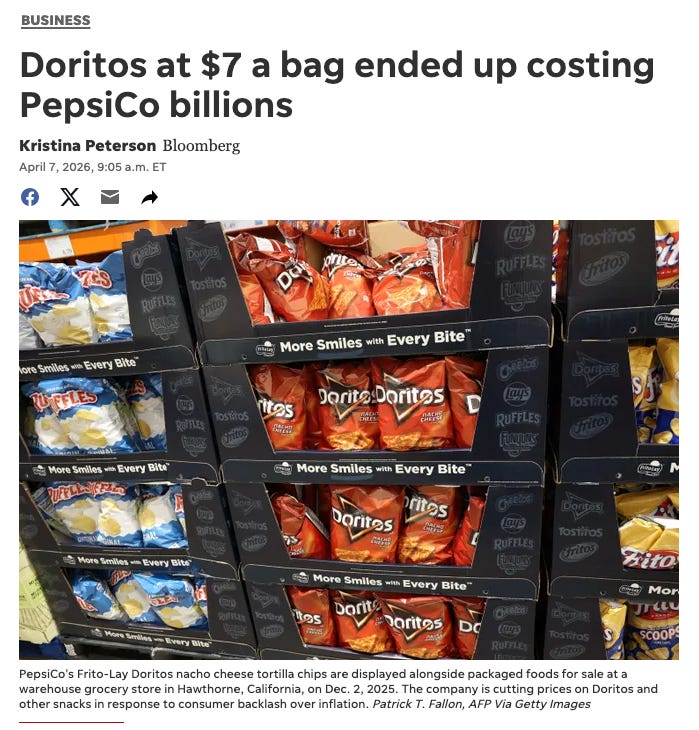
At face value, this headline can seem like clickbait, but underneath it is a host of poor leadership decisions that run completely against good marketing.
And, worth noting, decisions that are as easy to make in B2B tech as they are in the selling of chips.
Doritos prices jumped nearly 50% in 2021, a decision made during the pandemic to absorb higher supply-chain costs, like many other brands. But, for Frito-Lay, this didn’t just help then deal with costs - it ended up netting them a very attractive 13% revenue increase during that time. Pretty notable for a company that has long been in pursuit of 5% growth targets.
As a major market leading brand, the audience was willing to accept the higher prices, at least for a time. Such is a benefit of a strong brand and a good product.
Once those supply-chain costs and the pandemic passed, however, the price of Doritos did not.
And it didn’t seem to have immediate impact on sales. But it certainly had a big impact on short-term revenue, and so leadership decided to not interrupt this lucrative situation they found themselves in.
Even when their suppliers, such as Walmart, were telling them that they need to.
It’s all too easy for leading brands who are enjoying good numbers to forget that they, too, can be disrupted. And this hubris was very clear in the 2023 investor call for Frito-Lay, with a quote that belongs in marketing textbooks:
“No matter what happens with the consumer, we’re going to be, I think, the preferred choice.” - PepsiCo CEO Ramon Laguarta
But things did happen, and around 2023 the acceptance of these high prices from consumers changes radically. After a decade of positive revenue growth, 2024 saw real negative numbers and a major hit to their market value to the tune of $50 billion.
The company has recently responded with a 15% price but, but still comes in far above what it once was charging, and whether the cut will change the fortunes remains to be seen.
Maybe we could try tricking the consumer?
While price increases were the main factor in this major in this decision, it was certainly not the only lever being considered.
Some were trying to take advantage of market trends - offering options with fewer artificial flavors, higher protein - but there were also attempts to simply deliver less value to the customer.
PepsiCo tried some classic shrinkflation tactics like cheaper multi-packs with fewer bags inside, and giving away less product for that already increased price.
On its own, this is simply a terrible strategy and made much worse when there is pricing competition happening around you, as was the case for Doritos. Private labels, as well as a squeeze on consumer’s own finances made this disconnect all the more problematic.
This is at the heart of the 4Ps, and marketing as a function - to always represent the customer in company decisions as well as insights from the market.
When these aren’t present, companies look at product and price as levers to be adjusted, often convincing themselves that they have much more leeway in short-changing the customer than they truly have.
If we don’t deliver value to the customer, there is always someone else happy to do so.
Market share, even for a dominant leader like Doritos, doesn’t protect you forever if you forget who you actually serve.
Listen to the customer. Listen to the market.
The customer is the hero in all that we do. Our products and services exist to solve their problems in return for their custom, and that does not happen in isolation.
We exist in a dynamic and changing market, especially the technology sector.
If we solve real problems, then there will always be alternatives who are clamoring for the same customers that we seek. When companies reduce market to just promotion, we easily lose sight of this.
It causes us to see the product and its price as a series of levers, all too easily pulled in ways that reduce the value derived by the customer.
One of the benefits of brand is to allow for price increases, but this still must happen with full understanding of the world in which that brand competes.
The customer must experience value, and must do so for a better deal than what they can get elsewhere.
Whether we’re a better deal is not up to us but the customer.