
When Marketing is separated from Product, both come out worse
The org structure that has long been the standard in the tech industry creates fundamental marketing problems that make it harder to put the customer first.


For decades now, the tech industry has placed marketing and product into separate executive functions, and rarely as equals.
The DNA of the tech industry, and at least one of the founders, is typically product-centric and so it makes sense that product is at the heart of the organization.
But, as we’ve seen time and time again, the customer often isn’t.
Many products are solutions in search of problems, and many more are built to satisfy the customers they already have and not the future ones they want.
Marketing is seen as the function that takes a finished product and then make the market want it - and it’s a perspective that’s completely backwards.
Marketing and Innovation are two sides of the same coin
There’s a famous quote from Peter Drucker that bears repeating as often as possible:
“Because the purpose of business is to create a customer, the business enterprise has two--and only two--basic functions: marketing and innovation. Marketing and innovation produce results; all the rest are costs.”
Marketing isn’t the function that figures out how to make people want the product but rather the process of understanding the customer well enough that it produces products that solve their problems.
It’s intrinsically linked to innovation because it’s what provides the insights and understanding on which to innovate. One can’t happen before or after the other because both fuel the other.
It’s a mobius strip of thinking, and yet both aspects are separated structurally.
In fact, marketing often falls even farther down on the org chart, with constant debate about which of the ‘top-level’ CXOs it should fall under, including product itself.
Now I’m not naïve to think that I can write an article powerful enough to change the status quo of how tech orgs are built, but I do want to question why an industry that loves to see itself as a disruptor of the status quo has such a blind spot here?
Product vs Marketing
There are many problem that come from this organizational separation, but much of it comes back to this: marketing and product compete.
Usually not intentionally, or even consciously, but it does happen.
In a great Marketing Week article, Peter Weinberg & Jon Lombardo described what they called the ‘product delusion’, and it captures the reality perfectly:
“The product delusion is the belief that companies compete primarily on the quality of their product. The better the product, the stronger the sales. Brand barely matters.”
There is a growing acceptance now, with the disruption of AI, that brand is more of the moat than code, but this is little more than a soundbite when the org structure makes it near impossible to realize the belief.
Instead, it’s being overtaken by the VC push to make marketing as small and efficient a function as possible, with many marketing influencers getting on board with the narrative and even advancing it.
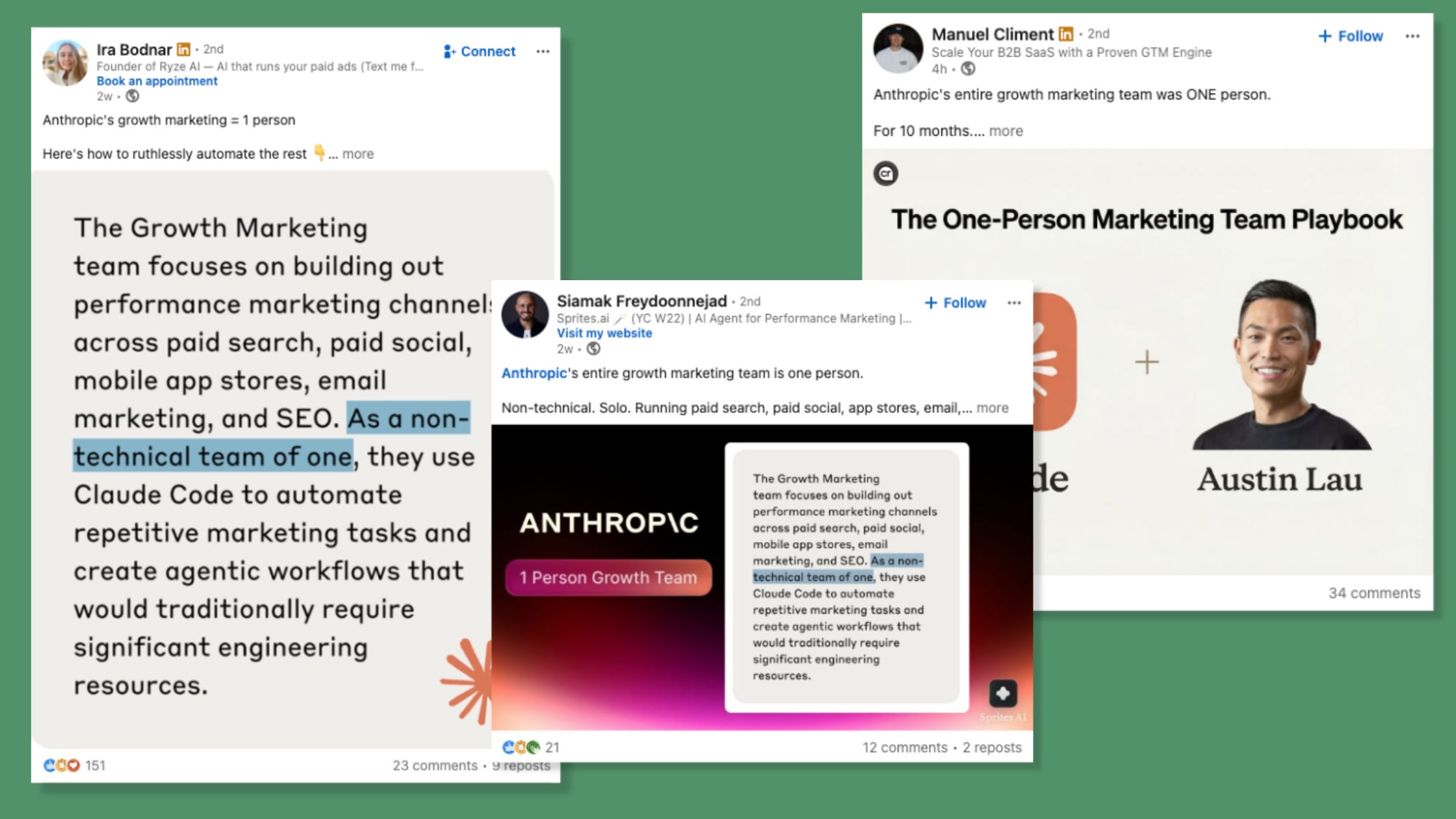
The core belief is that great products are the cause of growth and marketing is about efficiently putting that product in front of people to let it do its work.
But it gets even more messy when it comes to credit.
Marketing is held to an attribution model, where growth is all about what it directly and incrementally added to the pipeline, and this creates product vs marketing problems.
Product-led-growth (PLG) is still a major growth strategy for companies in tech, and the name says it all - the product is so good that it creates its own growth momentum, and products can be built to enable viral expansion.
When you combine this with marketing attribution, you end up with a troubling combination where the product is assumed to be the main driver of growth and marketing is adding value by showing how many people it added to that growth engine.
This is an incredibly difficult structure to unwind, and one where credit is competitive between marketing and product - by design.
The sincere hope is that the product creates its own momentum, like a perpetual motion machine, needing only the initial fuel from marketing to start it, and hopefully eventually won’t even need it.
The brand moat must somehow work around this, and that’s a tall order.
A broken belief about how marketing works
There’s another knock-on effect that isn’t just a tech problem, where marketing that’s reduced to promotion causes false beliefs about the power of promotion itself.
In another great Marketing Week article published today, Professor Byron Sharp of the Ehrenberg-Bass Institute challenged a report that got widespread attention in the advertising world:

The report, was a “large-scale effectiveness case evidence (1,265 campaigns across the U.S., Europe, UK, and Ireland, representing $139 billion in market share) and creative measurement (consumer responses from more than 200,000 people)” that presented some very exciting claims, backed by data.
But, as Prof. Sharp put it:
I wish I could believe, but it’s simply not true.
System1 and Effie have released a report, ‘The Creative Dividend’, claiming advertising is such a powerful force that it should be given much of the credit for sales, profits and other good business effects.
Well, of course they would.
When advertising is all that marketing owns, it has little choice but to believe that advertising is capable of amazing things, and this is just as much of a problem in tech.
Pair this with an organizationally reinforced belief that the product is the hero of the story, and you create a system where marketing has little choice but to be a force that controls and corrals the audience towards the product.
It should come as little surprise that marketing delves so deeply into tactics that are essentially spying on the audience and trying to push them into the trap that is the product (or sales process towards it).
In the article, Prof. Sharp makes the case that much of what we credit to advertising is biased - big business results don’t come come big campaigns, but rather big campaigns are what we put behind big company initiatives (like product releases) which then lead to big business results.
We simply cannot separate product from promotion.
Two functions: Marketing and Innovation
Back to Drucker’s point - the purpose of business is to create a customer, not a product.
Success as a founder, which tech needs constant reminding of, is not defined by the funding and valuation of a product, but it its actual ability to create customers at a profit.
The product matters, but only because the customer’s problems matters more. Marketing is understanding those problems, developing solutions to them, and creating customers through promotion that reflects the understanding.
Separation of product and marketing breaks this entire model, and puts the customer second.
When you build structure around that, it becomes harder and harder to truly innovate from, no matter how much you prioritize a ‘ship often’ thinking. It takes a very intentional leadership effort to be customer-centric through that, and frequently fails even with good intentions.
In the end, eventually, both customer and company lose out.
You make a very important point. I come from the FMCG world of soaps and toothpastes. And I can tell you from first hand experience tha product and marketing SHOULDN’T be separate functions. In fact, product innovation is considered a marketing role in my world